

 Dealing with Priority Vehicles and Verge Recovery
Two situations catch many learner drivers off guard on the CBR exam: an emergency vehicle rushing up behind you with lights and sirens, and the moment your wheels slip off the road surface onto the soft shoulder. Both require calm, decisive action — and both come up in the theory test more often than you might expect.
Priority vehicles (voorrangsvoertuigen)
How to recognise them
A priority vehicle is any emergency-service vehicle using blue flashing lights and a siren simultaneously. Think of ambulances, fire engines, and police cars. When both signals are active, every other road user — cars, cyclists, pedestrians — must yield immediately.
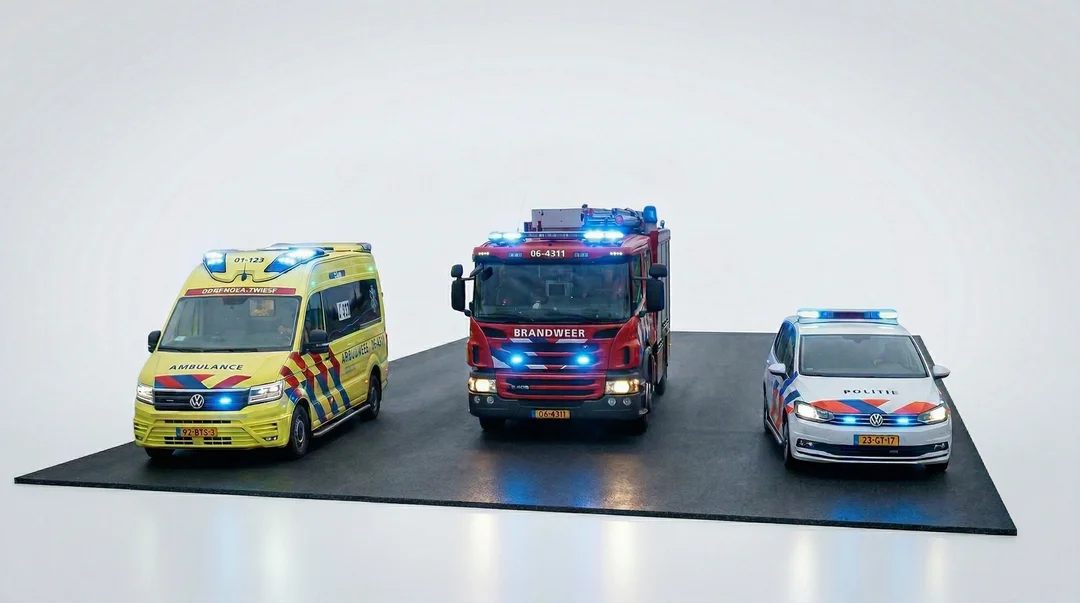
Priority vehicles are allowed to deviate from normal traffic rules — they may run red lights, exceed the speed limit, and ignore one-way restrictions. That is why every other road user must yield to them without hesitation.
Important nuance about the police: police officers are allowed to break traffic rules without activating their lights or siren — for example, when approaching a crime scene without warning suspects. However, this does not give them legal priority. Without blue flashing lights and a siren, a police car is legally a normal vehicle and must follow standard priority rules just like everyone else. If an unmarked or silent police car causes a collision while operating without signals, the officer is at fault.
Exam tip: A common trick question shows a police car at an intersection with no lights or siren and asks whether you must give way. The answer is no — treat it as a normal car and apply the standard priority rules. In real life, if a police car is behaving aggressively without signals, you should yield to avoid a collision — but on the CBR exam, the legal rule applies.
What to do when a priority vehicle approaches
The core rule is straightforward: let it pass as quickly and safely as possible. What that looks like in practice depends on where you are.
On a normal road:
- Move to the right to create space. You may pull onto a paved area such as a parking bay, but signal your intention before you move.
- If there is an open lane, leave it clear — do not switch into it.
- Never mount the pavement or break any traffic rule to make room. The priority vehicle will find its way; your job is to help, not to create a new hazard.
At a red traffic light:
- You may carefully edge forward a little to let the priority vehicle pass behind you — but you must not drive through the red light yourself.
On a motorway or dual carriageway:
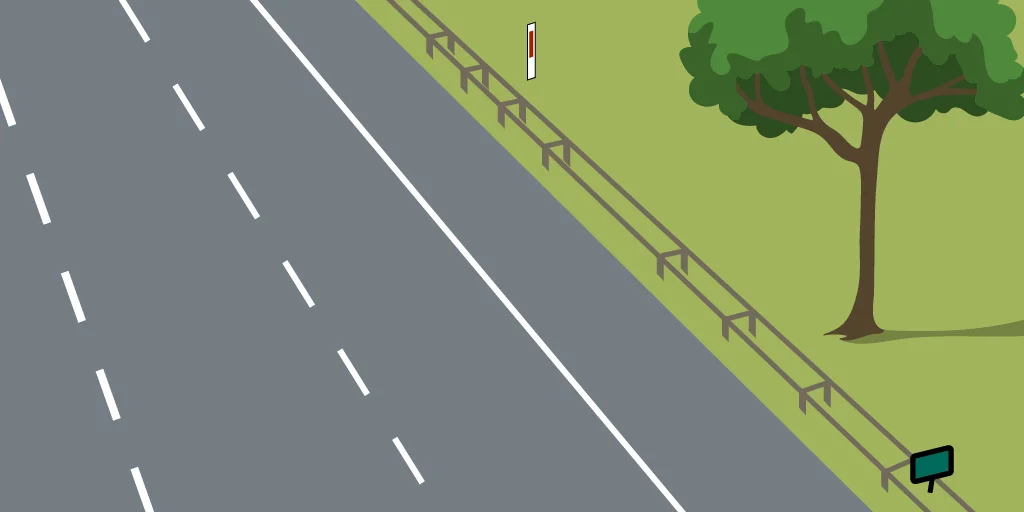
- When there is an emergency lane (vluchtstrook), priority vehicles use it. Keep that lane clear at all times.
- When there is no emergency lane, priority vehicles pass between the two leftmost lanes. In traffic jams, drivers in the left lane move further left and drivers in the next lane move right, creating a corridor in between.
On a roundabout:
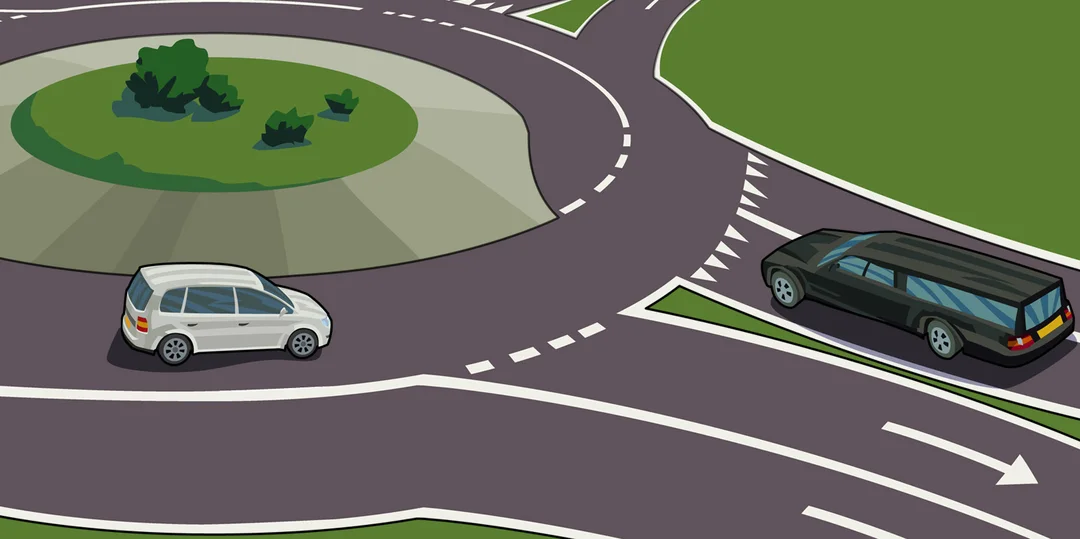
If you are already on the roundabout and a priority vehicle wants to take the same exit you do, drive one extra lap around the roundabout. This lets the emergency vehicle take the exit first without forcing either of you to stop awkwardly.
Watch out for more than one
Emergency calls often involve multiple vehicles — an ambulance followed by a fire engine, for instance. After the first vehicle passes, check your mirrors before pulling back into traffic. A second (or third) priority vehicle may be right behind it.
Exam tip: The CBR likes to test whether you know that more than one priority vehicle can be approaching. Always assume there might be another one coming.
Accidentally driving onto the verge (berm)
This situation is deceptively dangerous. Every year, serious accidents happen because a driver drifts off the road with two wheels on the soft shoulder and then panics — jerking the steering wheel or slamming the brakes. Both reactions can cause the car to skid, roll over, or swerve into oncoming traffic.
The best prevention is, of course, to always adapt your driving to the conditions — stay alert, keep both hands on the wheel, and avoid distractions so you never end up on the verge in the first place. But if it does happen:
Why it happens
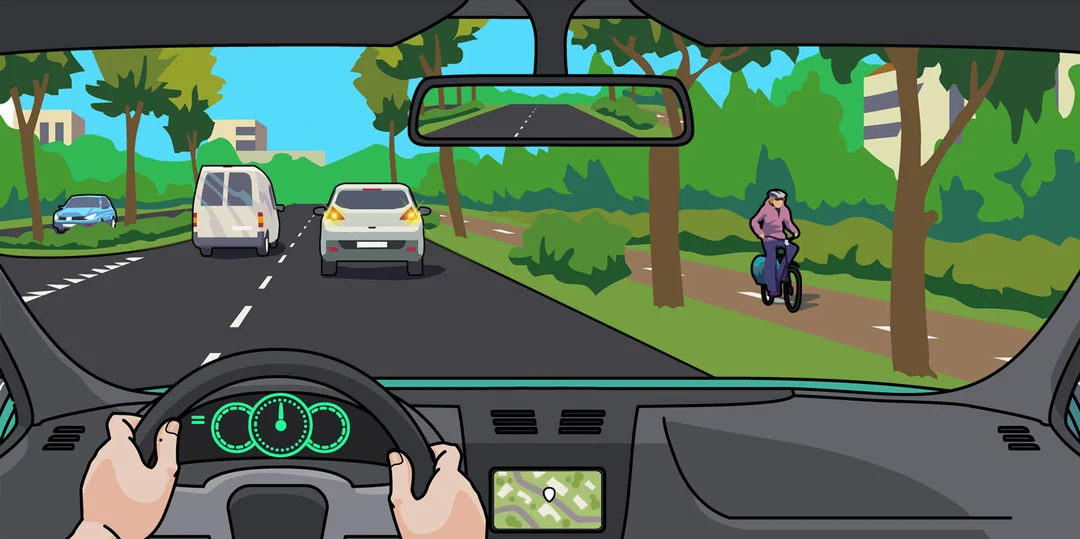
Common causes include distraction (looking at a phone, adjusting the GPS), fatigue, narrow roads, and strong crosswinds. Roads with trees close to the edge are especially risky — there is very little room for error.
The correct recovery technique
If your wheels end up on the verge, follow these steps in order:
- Stay calm. Panic is your biggest enemy.
- Keep driving straight. Hold the steering wheel firmly and resist the urge to steer immediately back onto the road.
- Ease off the accelerator. Let your speed drop gradually — do not brake hard, because the difference in grip between the road surface and soft ground can pull the car sideways.
- Steer back gently once your speed is very low. Only then is it safe to guide the car back onto the paved surface.
The one exception
If there is an obstacle directly ahead — a pole, a tree, a crash barrier — you have no choice but to brake carefully and try to steer towards a safe gap. This is the only situation where immediate action overrides the "slow down first" rule.
Exam tip: The CBR may describe a scenario where you drift onto the verge and ask what to do. The wrong answers usually involve braking hard or steering sharply at speed. The correct answer is always: keep straight, release the gas, and wait until your speed is low before steering back.
Quick recap
| Situation | Key action |
|---|---|
| Priority vehicle with lights + siren | Yield immediately — move right, signal, never break traffic rules |
| Police without lights or siren | Treat as a normal vehicle — no legal priority without signals |
| Priority vehicle on a motorway | Keep the emergency lane clear; no emergency lane → corridor between the two left lanes |
| Priority vehicle on a roundabout | Drive an extra lap to let it pass |
| After a priority vehicle passes | Check mirrors — another one may follow |
| Wheels on the verge | Stay calm, drive straight, release the gas, steer back only at low speed |
| Obstacle ahead while on verge | Brake carefully and steer to safety |