

 Vehicle Equipment: Trailers, Lighting & Cargo
Everything you need to know about towing trailers, using your vehicle's lights correctly, and transporting cargo safely — essential knowledge for the CBR theory exam.
Part 1: Trailers & Towing
Which Driving Licence Do You Need?
The licence category required for towing depends on the maximum permitted mass (empty weight + maximum payload) of your trailer or caravan. The following rules apply to category B licences issued on or after 19 January 2013.
Category B allows you to:
- Tow any trailer with a maximum permitted mass of 750 kg or less, regardless of the car's weight.
- Tow a heavier trailer (over 750 kg) provided the combined maximum permitted mass of car + trailer does not exceed 3,500 kg.
Category B+ (code 96) allows you to:
- Tow any trailer as long as the combined maximum permitted mass of car + trailer stays within 4,250 kg.
Category BE allows you to:
- Tow a trailer with a maximum permitted mass of up to 3,500 kg (the combined weight may then exceed 3,500 kg).
Key rule: If your trailer weighs 750 kg or less, the combined weight of car and trailer may exceed 3,500 kg on a standard B licence. Once the trailer exceeds 750 kg, the 3,500 kg combined limit applies strictly.
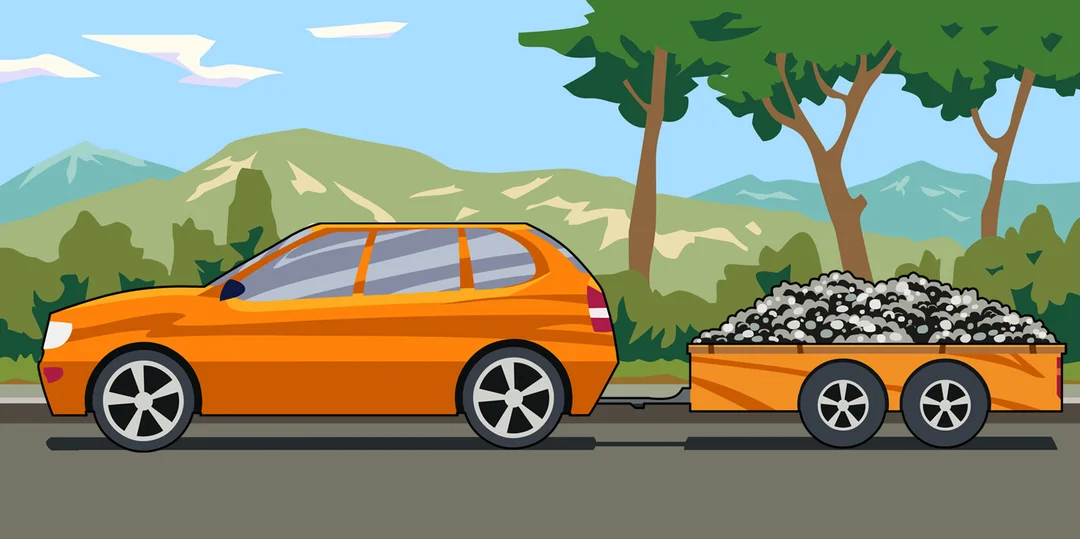
Practical Examples
| Car (max. permitted mass) | Trailer | Combined | Licence needed |
|---|---|---|---|
| 3,000 kg | 650 kg | 3,650 kg | B ✅ (trailer ≤ 750 kg) |
| 2,500 kg | 900 kg | 3,400 kg | B ✅ (under 3,500 kg) |
| 3,000 kg | 850 kg | 3,850 kg | B+ (code 96) |
| 2,500 kg | 2,000 kg | 4,500 kg | BE |
Maximum Trailer Dimensions
- Width: 2.55 m maximum
- Height: 4 m maximum
- Length: 12 m maximum (trailer alone)
- Total combination length (car + trailer): 18 m maximum
Towing Capacity
Never exceed the towing capacity listed on your vehicle registration certificate. The towed weight must always remain within this limit.
The Tow Bar
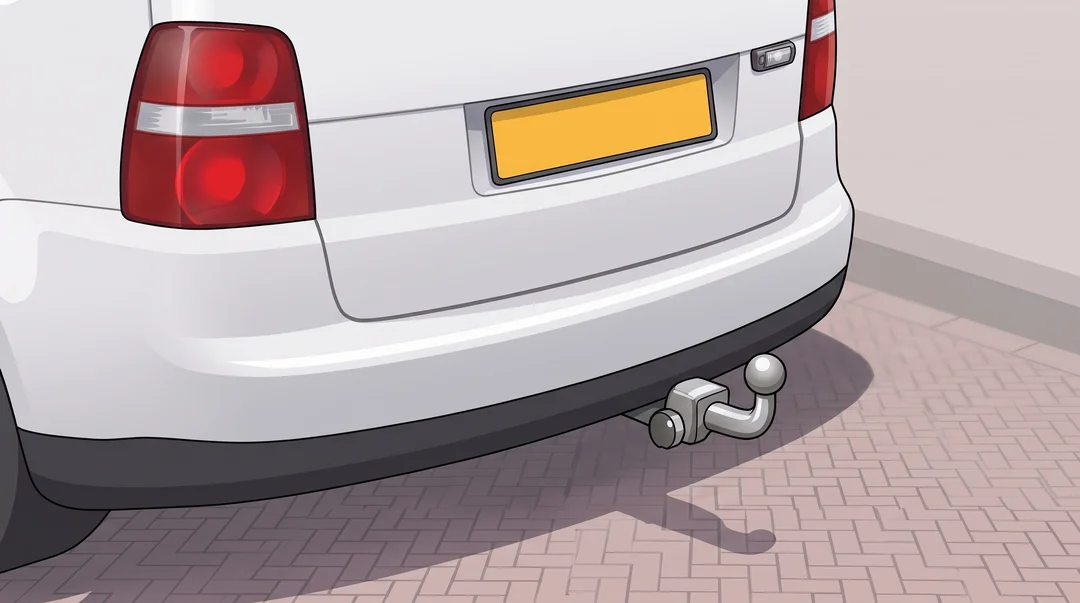
A tow bar (tow hitch) is mounted at the rear of your car and serves to pull a trailer, caravan, or attach a bicycle carrier. It must be:
- Securely fitted to the vehicle.
- Positioned so it does not block the number plate from view.
Breakaway Brake System
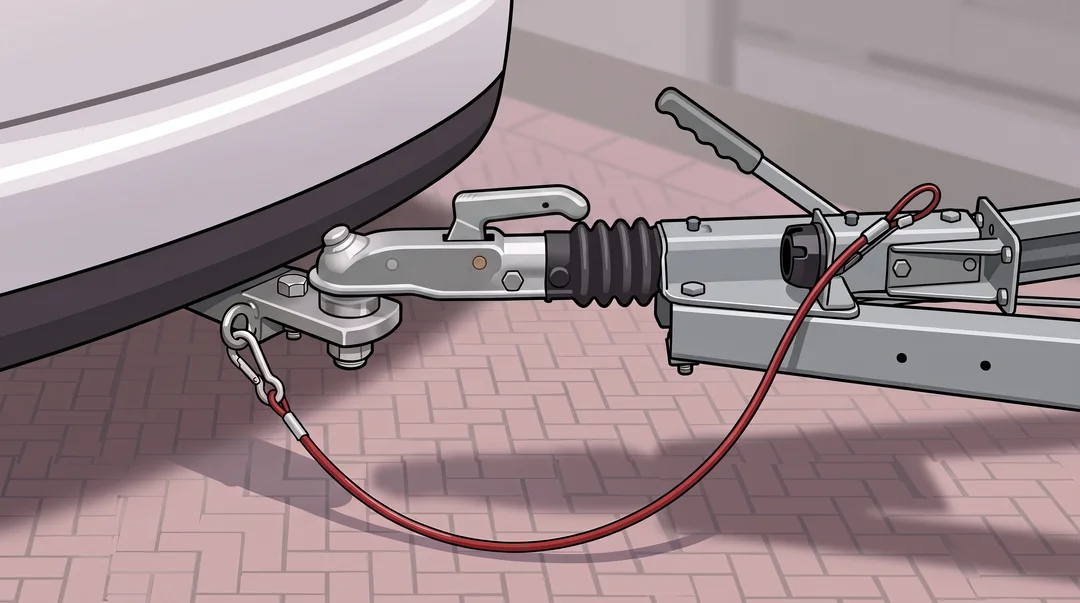
A breakaway brake device automatically applies the trailer's brakes if the connection between a braked trailer and the towing vehicle fails. The breakaway cable snaps, triggering the brakes and bringing the trailer to a halt.
- A breakaway cable is mandatory for trailers with a maximum permitted mass exceeding 1,500 kg.
How to Attach the Breakaway Cable
Fasten the cable directly to the towing vehicle or to a dedicated attachment point on the tow bar. Most tow bars feature a drilled hole or bracket designed for this purpose. Never attach it to the neck or head of the tow bar — if the coupling head fails, it will likely stay attached to the trailer, preventing the breakaway switch from activating.
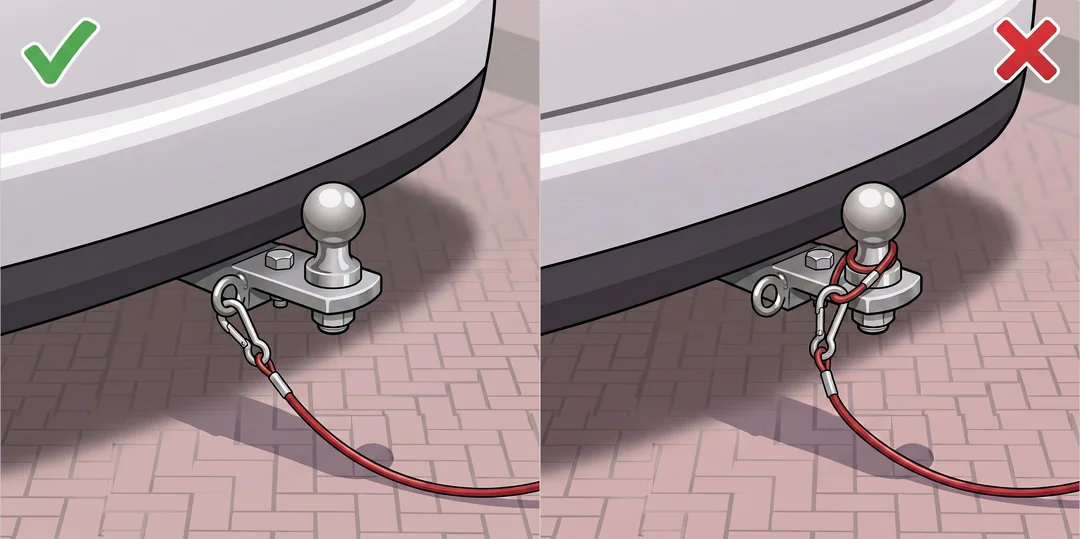
Secondary Coupling (Safety Cable)
A secondary coupling provides a backup connection between the trailer and the car using a steel cable. Should the main coupling fail, the trailer remains physically linked to the vehicle.
- Permitted only for trailers with a maximum permitted mass of 1,500 kg or less.
- Mandatory on all unbraked trailers.
Important: Never use a breakaway cable and a secondary coupling at the same time — they work in opposite ways. A secondary coupling can prevent the breakaway cable from activating the brakes when a braked trailer detaches.
Nose Weight (Ball Weight)
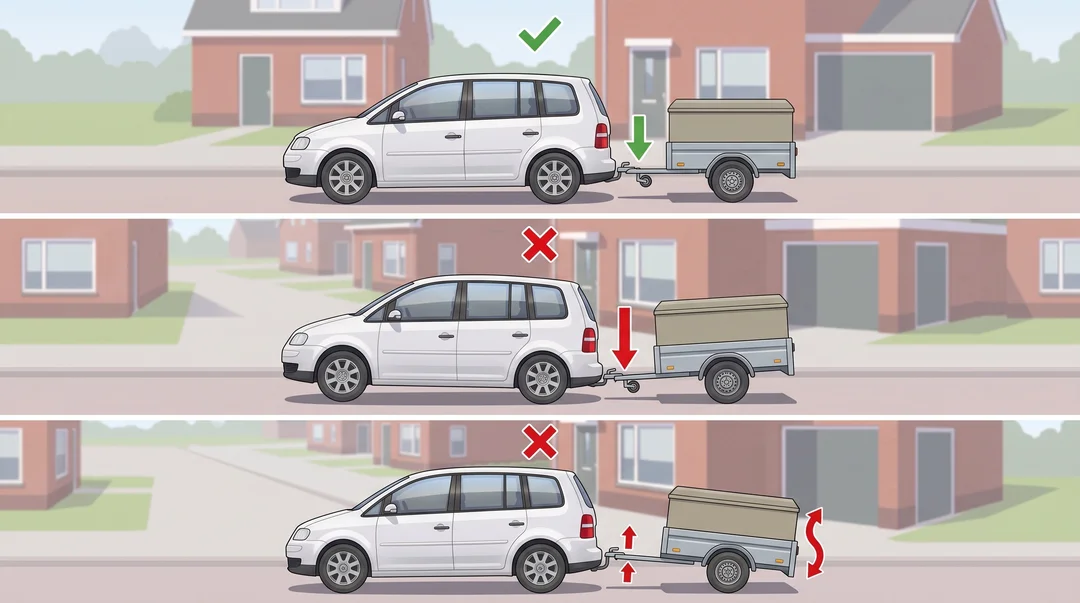
Nose weight is the downward force the trailer's drawbar exerts on the tow ball. Correct loading is critical for stability:
- Too much nose weight overloads the coupling and the car's rear axle.
- Too little nose weight causes the trailer to sway dangerously.
- The ideal nose weight is close to the maximum allowed — this provides the best stability and road-holding.
- Check the maximum values in your car's manual and the trailer coupling specifications.
Securing the Load on a Trailer
Cargo must never be at risk of falling off. You are required to cover or restrain the load whenever there is any chance it could come loose while driving. Suitable methods include trailer nets, tarpaulins, and ratchet straps.
Trailer Licence Plates
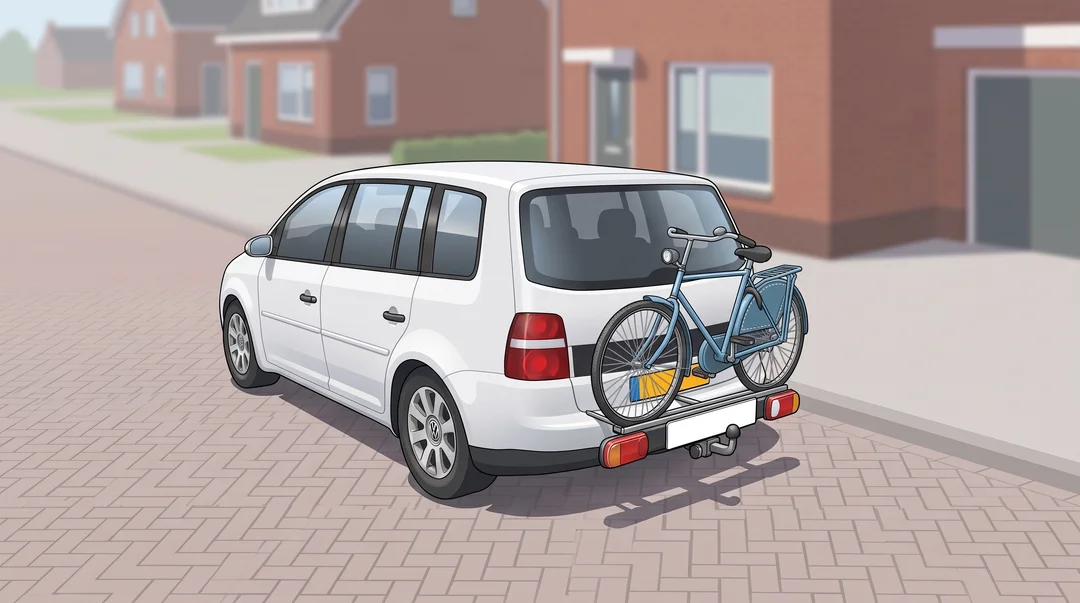
- Trailers and caravans of 750 kg or less, and accessories that obscure the car's plate (such as bicycle carriers), must display a white number plate bearing the car's registration, from an approved supplier.
- Trailers and caravans over 750 kg require their own registration and a yellow number plate with an approval mark.
Towing on Motorways and Autowegen
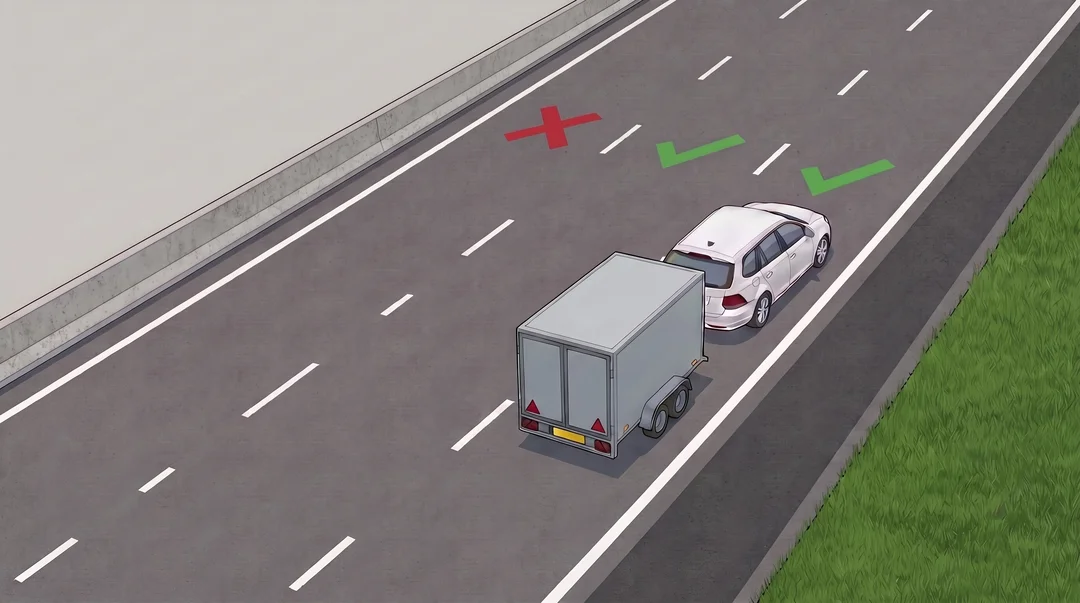
Motor vehicles towing a trailer where the total combination exceeds 7 metres in length are restricted to the two right-hand lanes when three or more lanes are available. This rule also counts an open rush-hour lane as a regular lane. The restriction does not apply when you need to move to another lane to reach your destination.
Mandatory Lighting on Trailers
Every trailer must be equipped with:
- 2 rear lights and 2 brake lights
- Number plate illumination
- 2 rear direction indicators
- 2 red rear reflectors and 2 white front reflectors (trailers registered after 31 Dec 1997)
- 1 rear fog lamp (trailers after 31 Dec 1997)
- Amber side reflectors
- 1 reversing light
- 2 side marker lights (if wider than 1.60 m)
- 2 front end-outline marker lights (if wider than 2.10 m, after 31 Dec 1997)
- Side end-outline marker lights (if longer than 6 m, after 31 Dec 1997)
Part 2: Vehicle Lighting
Correct use of lights keeps you safe and visible. Every vehicle must have working lights — you may not drive with faulty lighting, even during daytime.
Dipped Beam Headlights (Low Beam)
Dipped beam is your primary driving light. It projects a downward-angled beam that illuminates the road without blinding oncoming drivers. You must switch on dipped headlights whenever:
- It is dark or night-time
- Visibility is reduced (fog, rain, snow, hail, dusk)
- You enter a tunnel
- The sun is low on the horizon
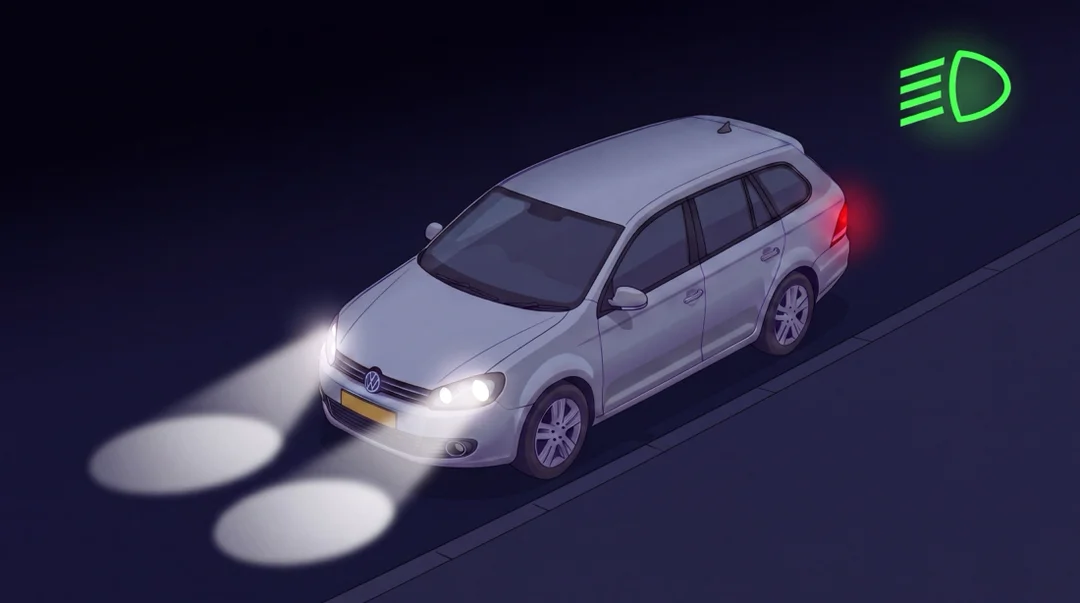
Dipped headlights are not required when front fog lights are already switched on.
Full Beam Headlights (High Beam)
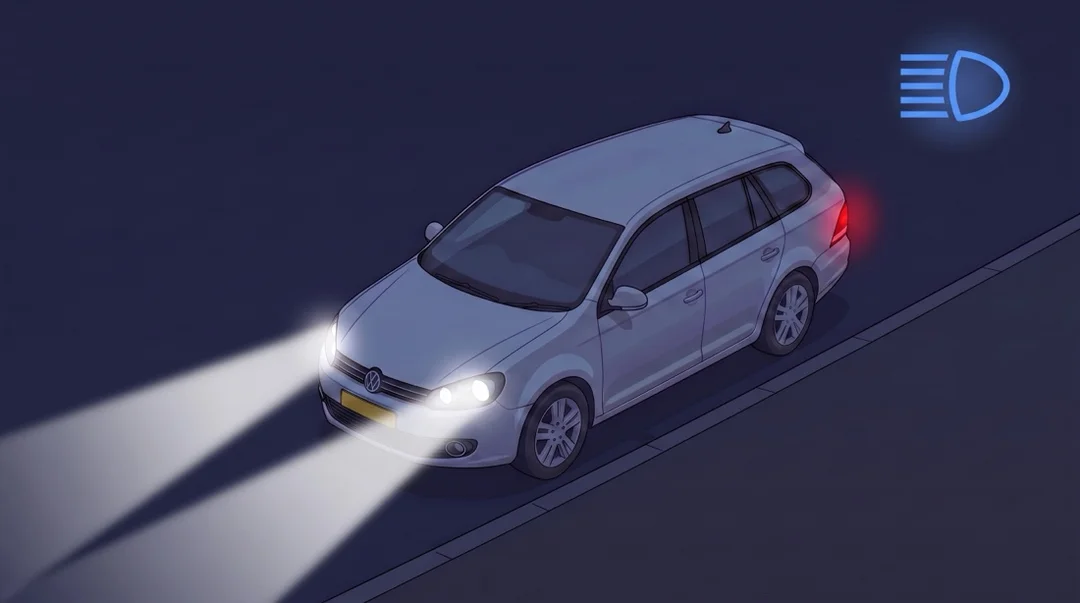
Full beam provides maximum forward illumination but can severely dazzle other road users. Use full beam only when no other traffic is nearby.
You must not use full beam:
- During daytime
- When facing oncoming traffic
- When driving closely behind another vehicle
Side Lights / Parking Lights
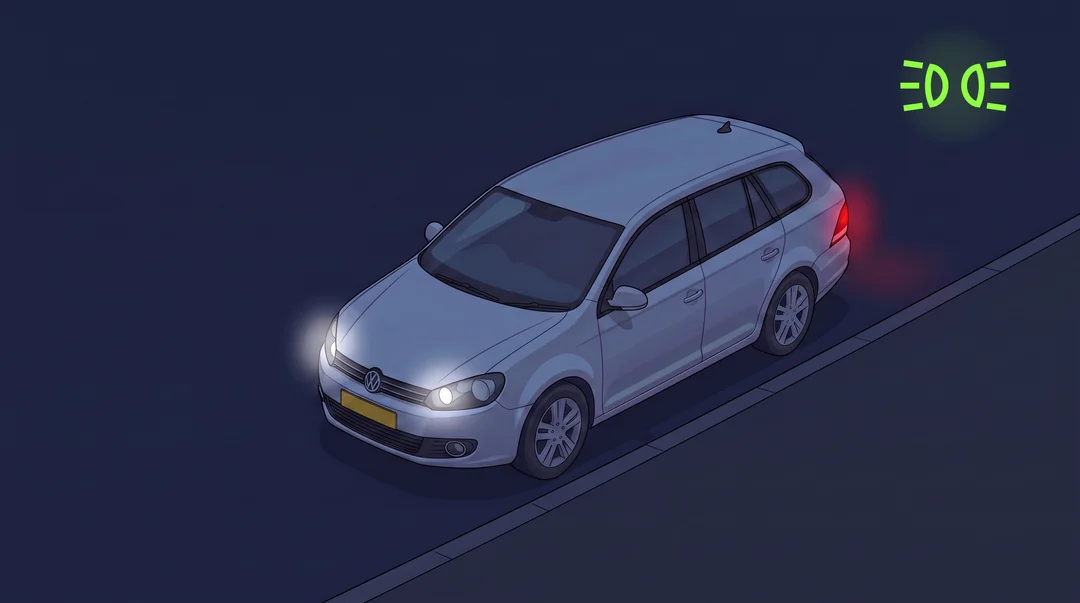
Parking lights are not driving lights. You use them when your vehicle is stationary in darkness or poor visibility:
- On the carriageway outside built-up areas
- On a parking strip, lay-by, hard shoulder, or emergency lane alongside a motorway or autoweg
If you must stop in a spot where approaching drivers might not see you clearly, switch on your side lights and rear lights to increase visibility.
Fog Lights
Fog lights help you see and be seen in extreme weather. Different rules apply to front and rear fog lights.
Front Fog Lights
Front fog lights emit a wide, low beam. You may use them only when visibility is seriously restricted due to fog, snowfall, or rain. Many theory sources use about 200 metres as a guideline.
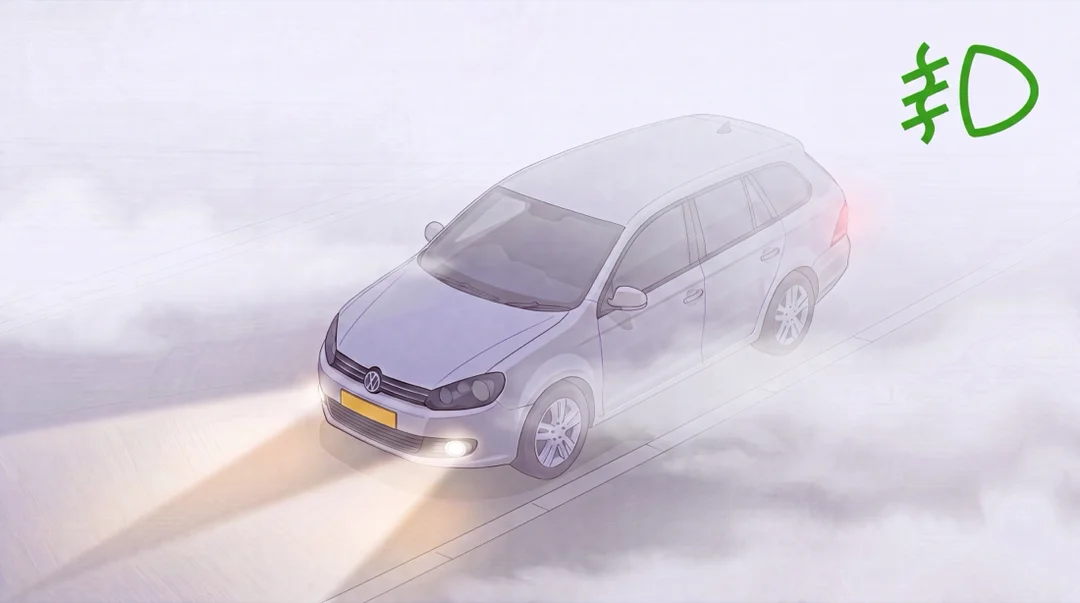
When front fog lights are on, dipped headlights do not need to be activated separately.
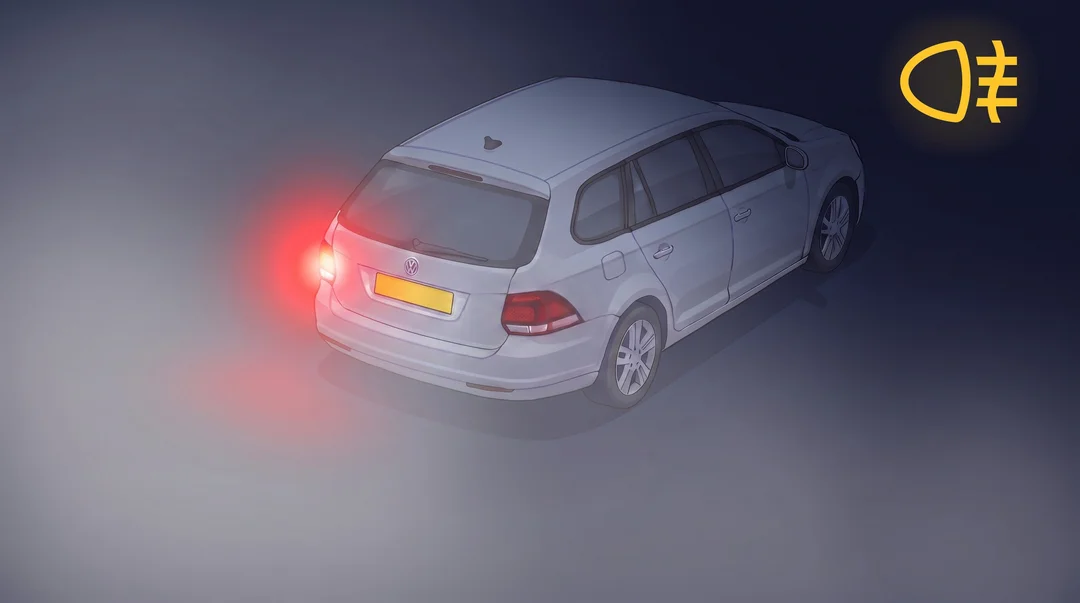
Rear Fog Light
The rear fog light is extremely bright and can dazzle the driver behind you. Use it only when visibility falls below 50 metres due to fog or heavy snowfall.
The rear fog light must never be used in rain — rain alone does not reduce visibility to under 50 metres in the way fog or snow does.
Daytime Running Lights
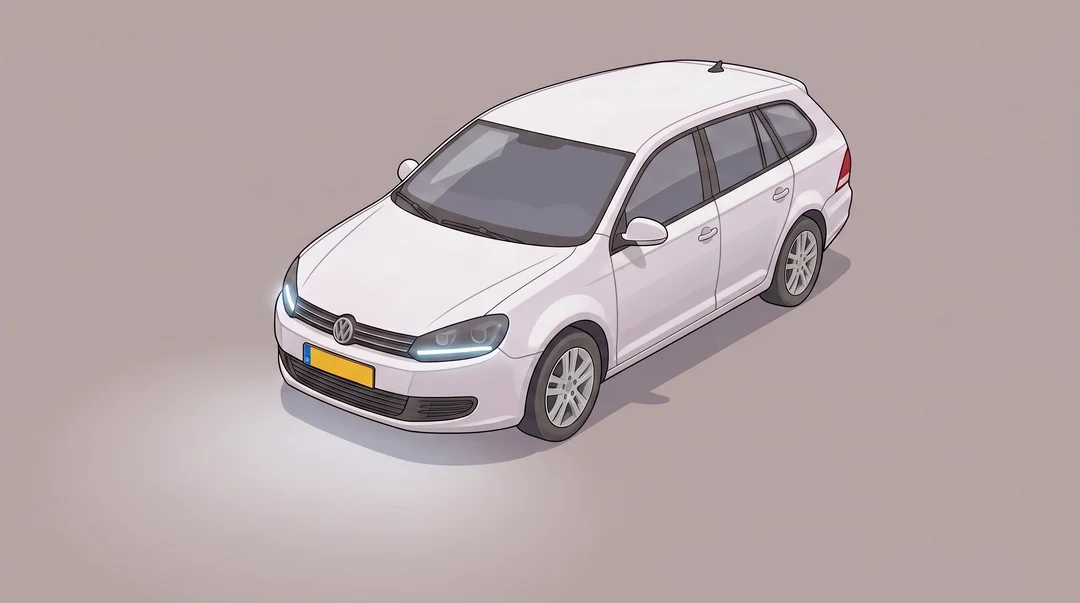
Many modern cars are fitted with daytime running lights (DRLs) that switch on automatically. Since 2011, all new cars sold in Europe must have them. DRLs improve daytime visibility but are not sufficient in darkness or poor weather — you must switch to dipped headlights in those conditions.
DRLs must not be lit simultaneously with other front lights.
Rear Lights & Number Plate Lights
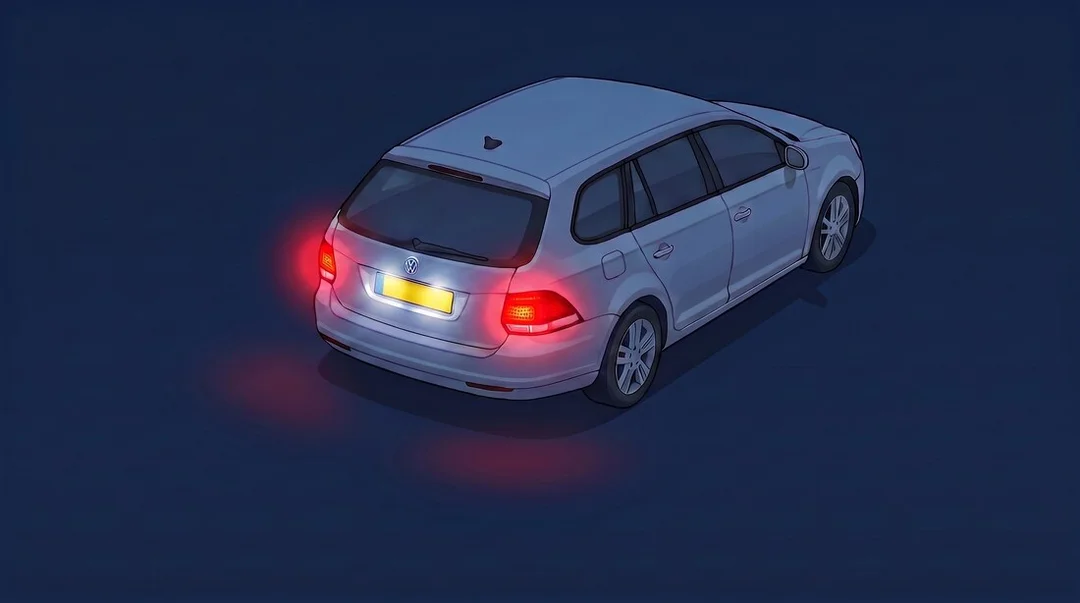
Rear lights and number plate illumination come on automatically whenever you activate dipped headlights, full beam, side lights, or fog lights.
Brake Lights
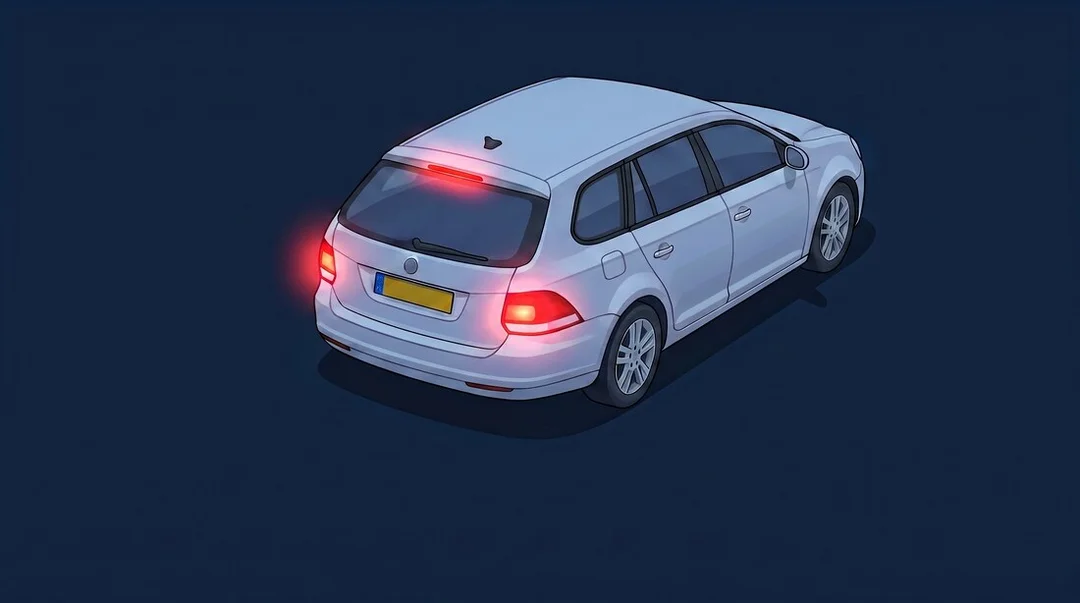
Brake lights activate the moment you press the brake pedal. Since 2001, all new cars in the Netherlands must have a third (centre) brake light.
Hazard Warning Lights
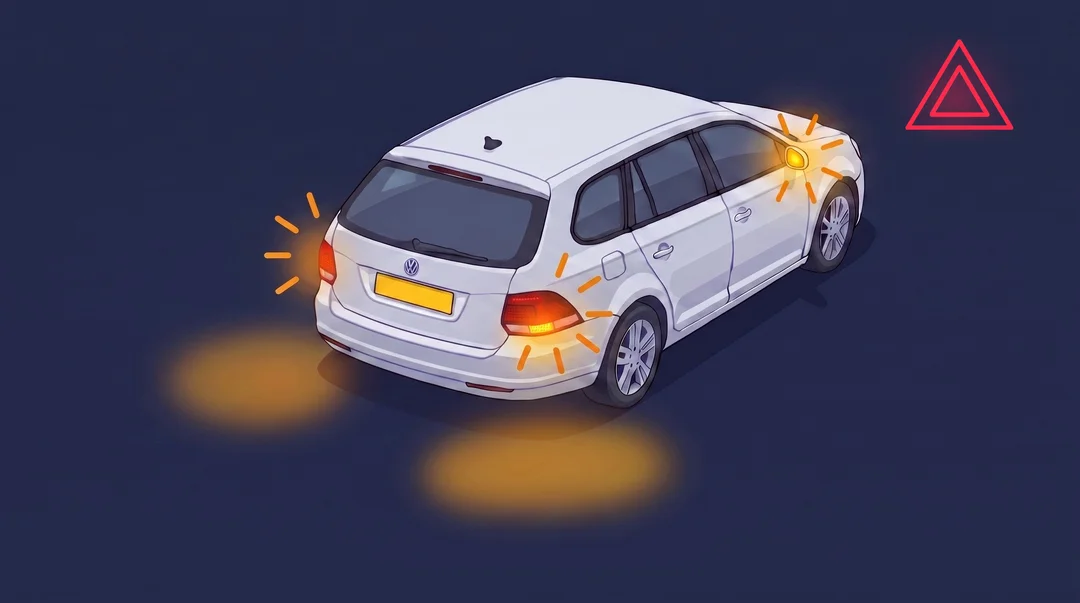
Activate your hazard lights when:
- Your vehicle has broken down
- You are stopped or parked in a dangerous or poorly visible location
- You are approaching a traffic jam on the motorway
With hazard lights flashing, placing a warning triangle is not mandatory — but doing so adds an extra layer of safety.
Direction Indicators (Turn Signals)
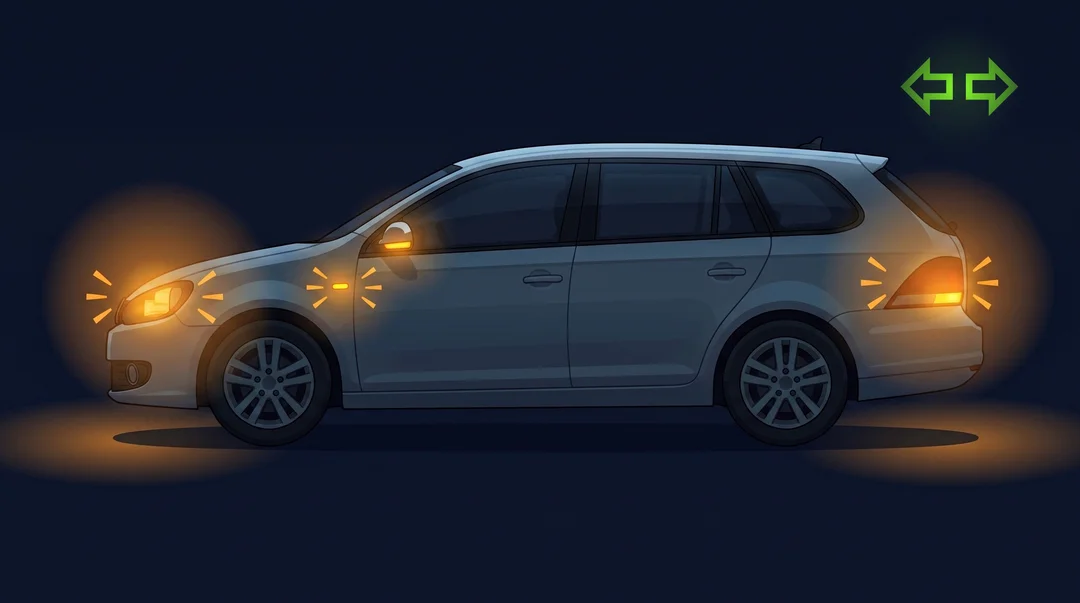
Signal your intentions well in advance so other road users can anticipate your movement. You must indicate for every significant lateral change of position, including:
- Pulling away from the kerb
- Overtaking
- Joining or leaving the main carriageway
- Turning at intersections
- Changing lanes
- Swerving around an obstacle
- Positioning for a turn
- Exiting a roundabout
Switch off the indicator immediately after completing the manoeuvre.
Recommended Signalling Distances
- Motorway / autoweg: 300 m before the exit lane
- Outside built-up areas: 150–200 m before an exit or intersection
- Within built-up areas: 50–100 m before an exit or intersection
- Residential streets: 50 m
Reversing Lights
Reversing lights illuminate the area behind the vehicle and warn others you are about to reverse. They must emit white or yellow light when reverse gear is engaged.
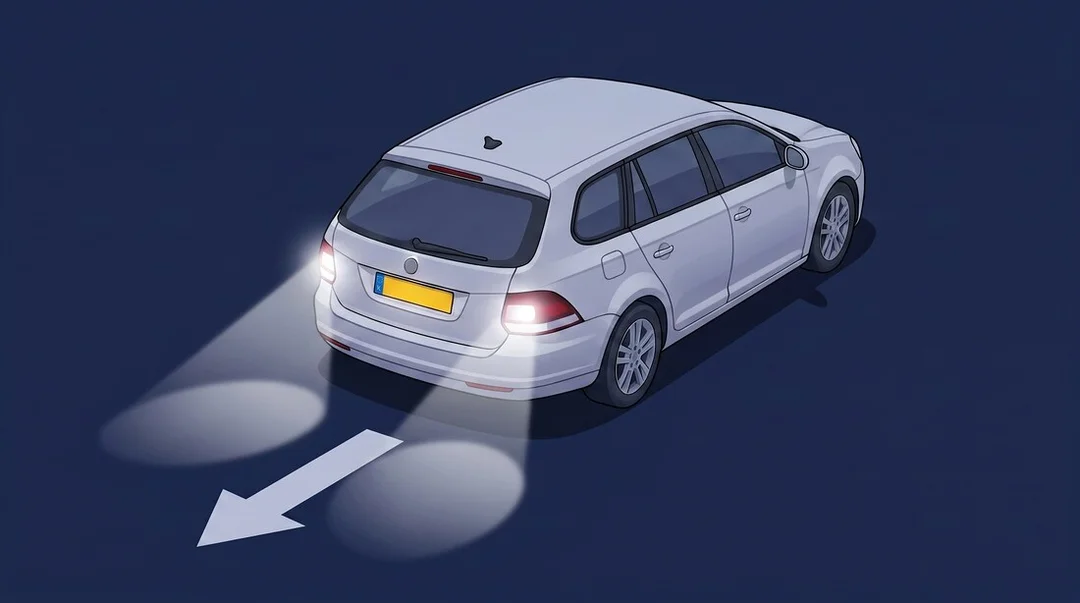
If you spot white or yellow lights at the back of a vehicle, be prepared — the driver is reversing.
Visibility & Speed
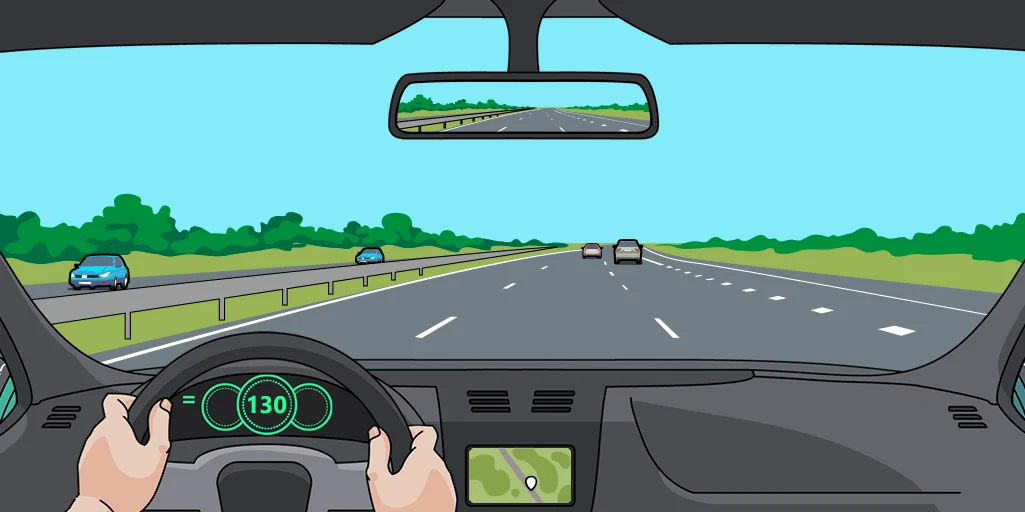
Good visibility is directly linked to safe driving speed. On the motorway, the speed limit is typically 130 km/h — but only when conditions allow you to see far enough ahead to stop safely.
Required Lighting on a Passenger Car
You may not drive if any of these lights are defective — not even during daytime.
A passenger car must have:
- 2 dipped beam headlights and 2 full beam headlights
- 2 side lights (parking lights)
- 2 front direction indicators and 2 rear direction indicators (post-1997)
- Hazard warning lights (post-1997)
- 2 rear lights and 2 brake lights
- 1 third brake light (post-September 2001)
- 1 rear number plate light
- 1 rear fog light
- 1 reversing light
- Side end-outline marker lights (cars longer than 6 m, post-1997)
- Amber reflectors on each side (cars longer than 6 m, post-1997)
Light colours:
- Forward-facing lights and reversing lights → white or yellow
- Rear-facing lights → red
- Decorative lighting and under-car lights are not permitted.
Signals to Avert Danger
You may flash your lights or sound the horn to warn of immediate danger — for example, an impending collision, an oncoming driver blinding you with full beam, or a vehicle driving at night without lights. Unnecessary honking (e.g. greeting someone) is fineable. Signals must never last longer than necessary.
Part 3: Cargo & Load Rules
Fundamental Principles
When transporting any load, three basic rules always apply:
- The load must not obstruct the driver's view.
- The load must be properly secured and must not endanger anyone.
- The load must not cover the number plate or any lights.
Maximum Vehicle Dimensions (Including Load)
| Dimension | Limit |
|---|---|
| Width | 2.55 m (2.20 m on unpaved roads) |
| Height | 4.00 m |
| Length (car alone) | 12 m |
| Length (car + trailer) | 18 m |
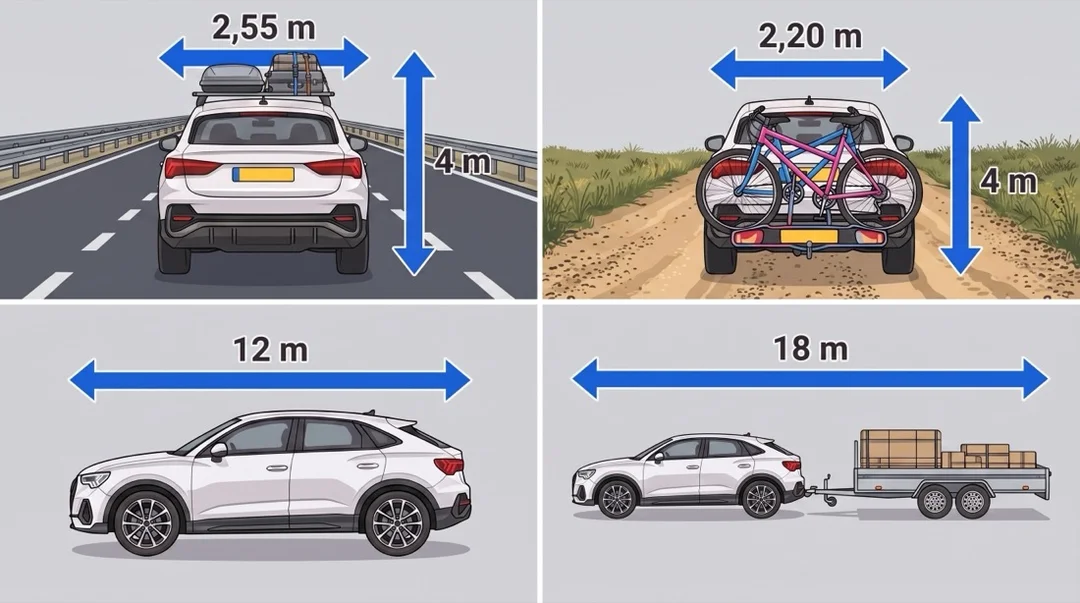
Divisible vs. Indivisible Loads
- Divisible loads can be broken down or made smaller without special effort — think boxes, bags of groceries, or stacked bricks.
- Indivisible loads cannot be split apart without excessive cost or risk — for example, a ladder, canoe, or steel beam.
The distinction matters because indivisible loads are granted more generous overhang allowances than divisible ones.
Overhanging Load on a Passenger Car
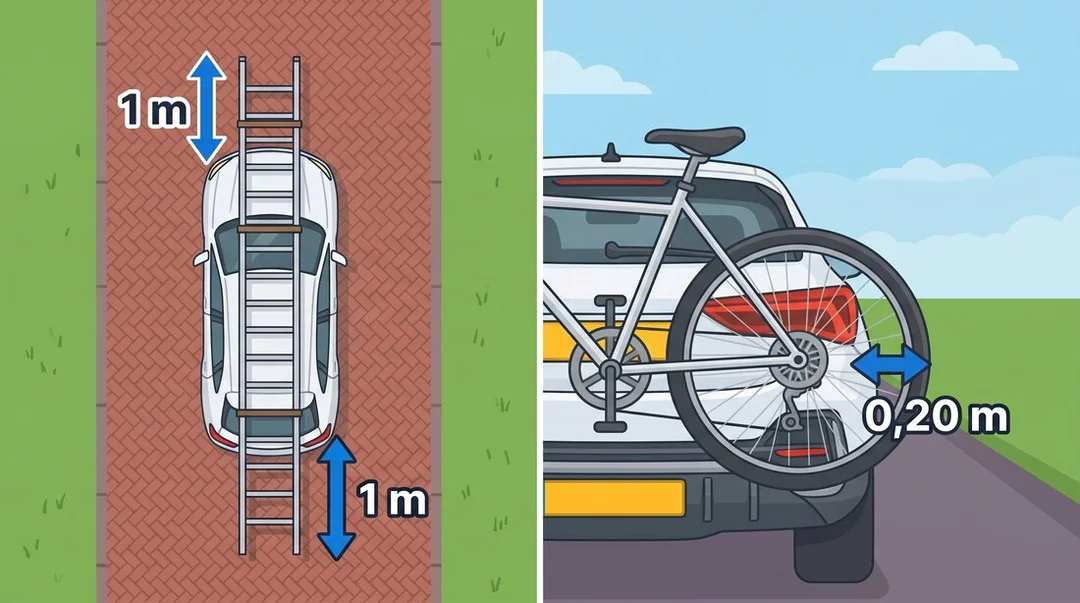
| Direction | Divisible load | Indivisible load |
|---|---|---|
| Front | Must not protrude | Max. 1 m |
| Each side | Max. 20 cm | Max. 20 cm |
| Rear | Max. 1 m | Max. 1 m |
Overhanging Load on a Trailer
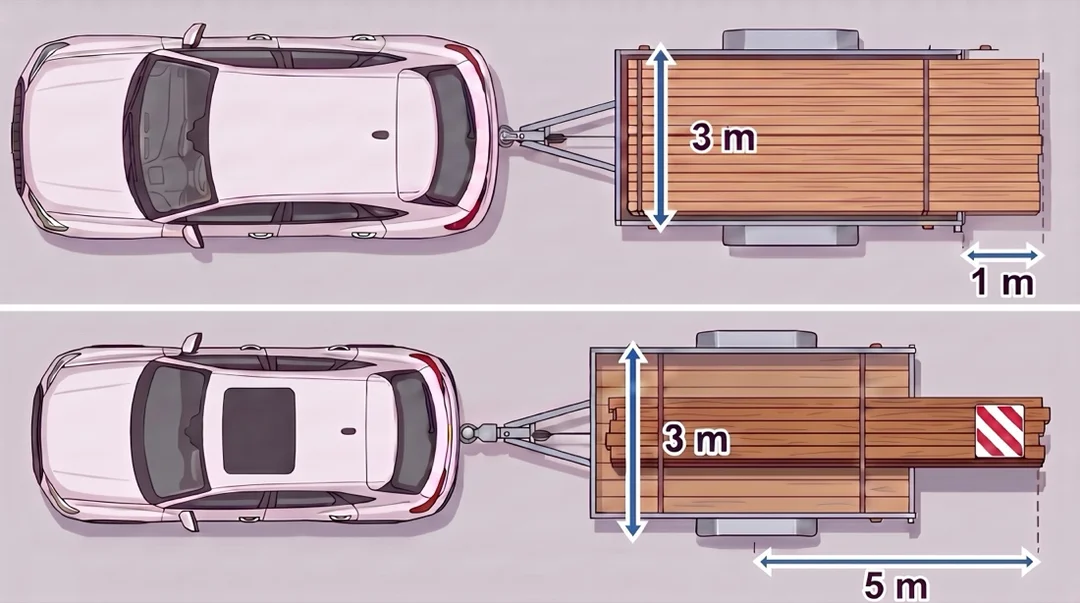
| Direction | Rule |
|---|---|
| Front (drawbar) | No load may protrude |
| Sides | Indivisible load may protrude if necessary, provided the trailer including load stays within 3 m wide |
| Rear — divisible | Max. 1 m beyond the trailer |
| Rear — indivisible | May exceed 1 m, up to half the trailer's length measured from the rear axle, with an absolute maximum of 5 m |
Example: A 6-metre trailer allows indivisible load to protrude up to 3 metres behind the rear axle (half of 6 m).
Marker Boards for Overhanging Loads
When a load extends significantly, it must be made visible with a marker board — a board bearing diagonal red-and-white stripes (7–10 cm wide), at least 42 × 42 cm in size.
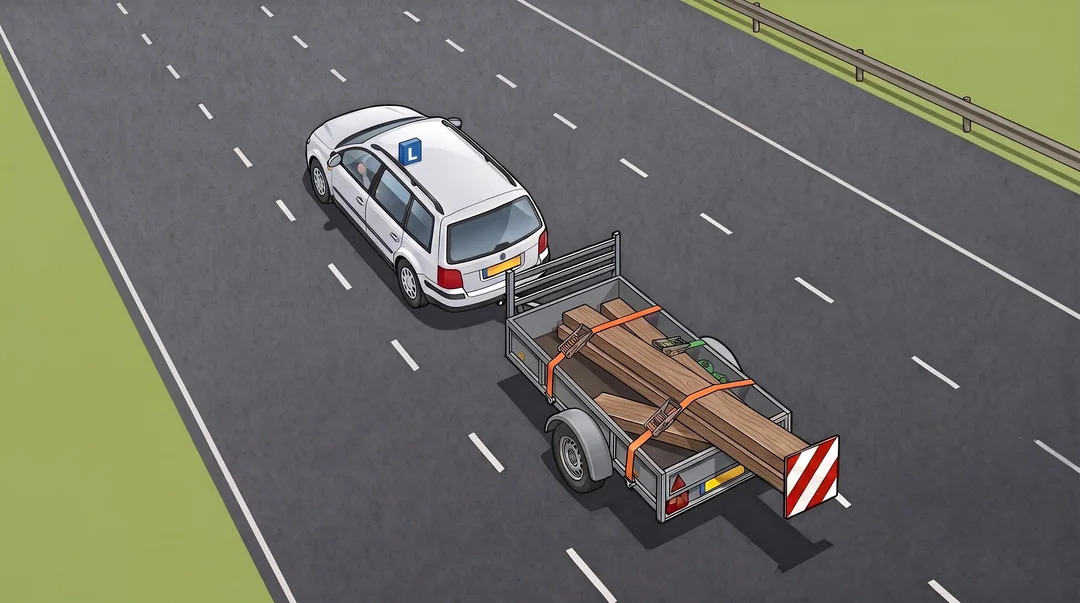
Length overhang: A marker board is required if the load extends more than 1 metre to the front or rear. Mount it perpendicular to the direction of travel on the protruding portion of the load.
Width overhang: If the load protrudes more than 10 cm to one side, marker boards must be placed at both front and rear (not required for passenger cars). Alternative board dimensions are acceptable (28 × 56 cm or 14 × 80 cm) as long as the surface area is equivalent.
Night-time: A marker board at the front must carry a white light, and at the rear a red light.
Passenger cars themselves are not required to use marker boards, but the load must still be clearly visible.
Load Carriers (Roof Racks, Bicycle Racks, Ski Boxes)
Load carriers have specific requirements:
- The carrier and its contents must be securely fastened.
- Neither the carrier nor the goods may protrude more than 20 cm on each side.
- A carrier designed for specific goods (e.g. bicycles) must not be used for other items.
- Never exceed the carrier's rated capacity.
- If the carrier or load obscures the number plate, fit a white plate with the vehicle's registration and plate lights (with an approval mark).
- Tow-bar-mounted carriers must not exceed the maximum nose weight.
- Roof-mounted loads require a proper carrier, and the maximum roof load must not be exceeded.
- Remove load carriers when not in use — an empty roof rack alone can increase fuel consumption by up to 30%.
Load Carrier Lighting
If the carrier or goods block the rear lights, the carrier must have:
- 2 red rear lights
- 2 red brake lights
- 2 red reflectors
- 2 direction indicators
Summary: Key Exam Points
| Topic | Key fact |
|---|---|
| Licence B trailer limit | Car + trailer ≤ 3,500 kg combined (or trailer ≤ 750 kg regardless) |
| BE licence | Needed when combined weight > 3,500 kg |
| Dipped headlights | Mandatory in darkness, rain, fog, snow, tunnels |
| Full beam | Never with oncoming traffic; never during daytime |
| Front fog lights | Only when visibility < 200 m |
| Rear fog light | Only when visibility < 50 m (fog/snow only — never in rain) |
| Daytime running lights | Not sufficient in darkness |
| Parking lights | For stationary vehicles only — not driving lights |
| Car max dimensions (incl. load) | 2.55 m wide × 4 m high × 12 m long |
| Overhanging load — car rear | Max. 1 m |
| Overhanging load — trailer rear | Up to 5 m (indivisible, from rear axle) |
| Marker board | Required when load extends > 1 m front or rear |
| Load carrier fuel impact | Up to +30% when left on unused |