

 Stopping and Parking in the Netherlands
One of the trickiest parts of the CBR theory exam is knowing exactly where you can — and cannot — leave your vehicle. Many students mix up stopping and parking, and the exam loves to test that confusion. Let's clear it up once and for all.
Stopping vs. Parking — The Key Difference
Before we talk about rules, you need to understand two Dutch traffic law terms that sound similar but mean very different things.
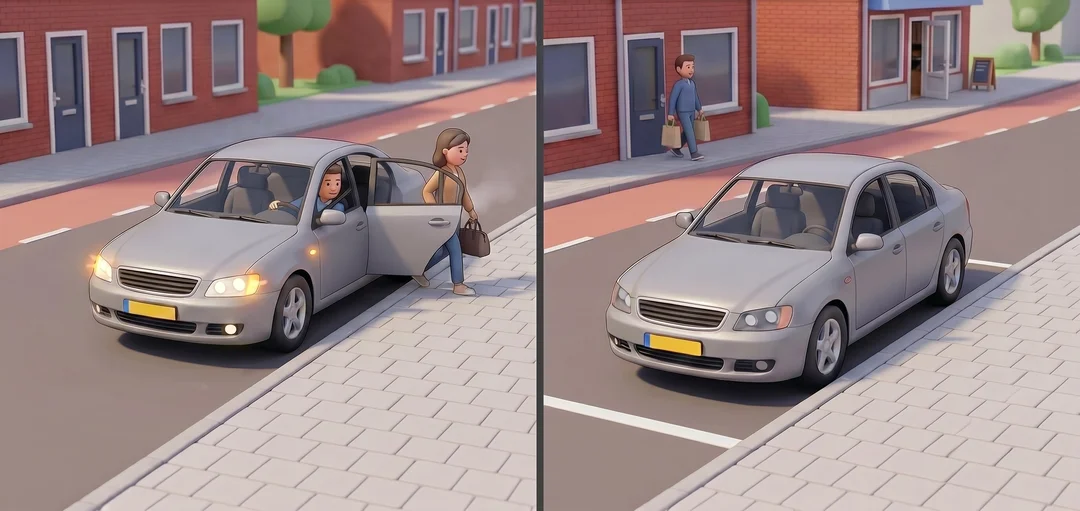
Stopping (stilstaan) means you voluntarily bring your vehicle to a halt and you remain with or directly at the vehicle, ready to move. You're considered "stopping" when you:
- Quickly pick up or drop off a passenger
- Immediately load or unload goods
The vehicle is stationary, but you're ready to move at a moment's notice.
Parking (parkeren) means your vehicle is left standing longer than what's needed for loading/unloading or picking up passengers. In practice, parking is when:
- You leave the vehicle to run into a shop
- You sit inside waiting for someone
- You pull over to make a phone call
- You walk away from the vehicle for any reason
Here's a simple way to think about it: stopping is brief and purposeful; parking is everything else.
One rule applies to both: you may never stop or park your vehicle in a way that causes danger or unnecessarily obstructs other road users. This overrides everything — even if there's no sign prohibiting it, if your vehicle creates a hazard, it doesn't belong there.
Where You Cannot Stop
If stopping is forbidden somewhere, then parking is automatically forbidden there too. These are the strictest zones — your vehicle simply cannot be stationary here at all (except when forced by traffic).
Sign E2 — No Stopping
The round blue sign with a red X is sign E2. It means: no stopping whatsoever on this side of the road. You cannot even pause briefly to drop someone off.
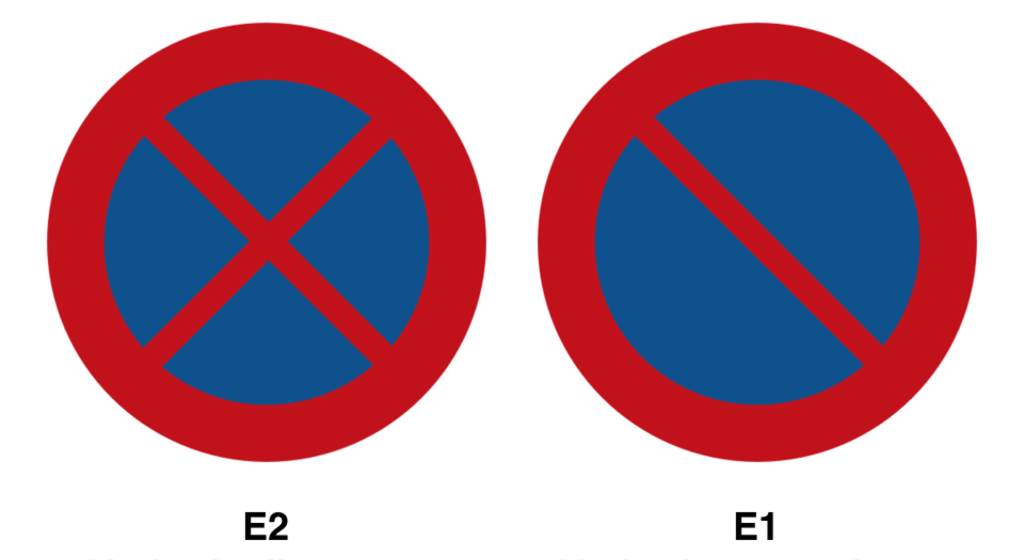
Important: E2 (and E1) apply only to the side of the road where the sign is placed. The opposite side may have different rules.
Dangerous and Poorly Visible Locations
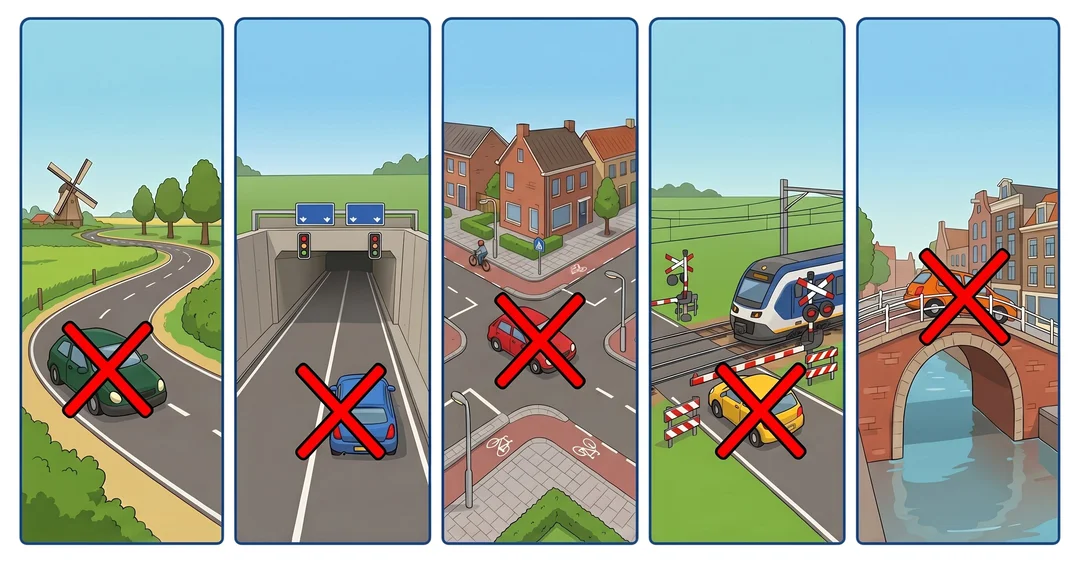
Common sense plays a big role here. You may not stop at places where your stationary vehicle would surprise other drivers or block their view:
- Bends — drivers coming around can't see you in time
- Tunnels — narrow, dark, and no room to manoeuvre
- Junctions and intersections — you'd block traffic flow and sightlines
- Level crossings (railway crossings) — extremely dangerous
- Hills and crests — approaching vehicles can't see you until it's too late
Paths Reserved for Others
Your car has no business standing on:
- Bicycle paths (fietspaden)
- Footpaths (voetpaden)
- The carriageway next to a bicycle lane or bus lane — you'd force cyclists or buses to swerve into traffic
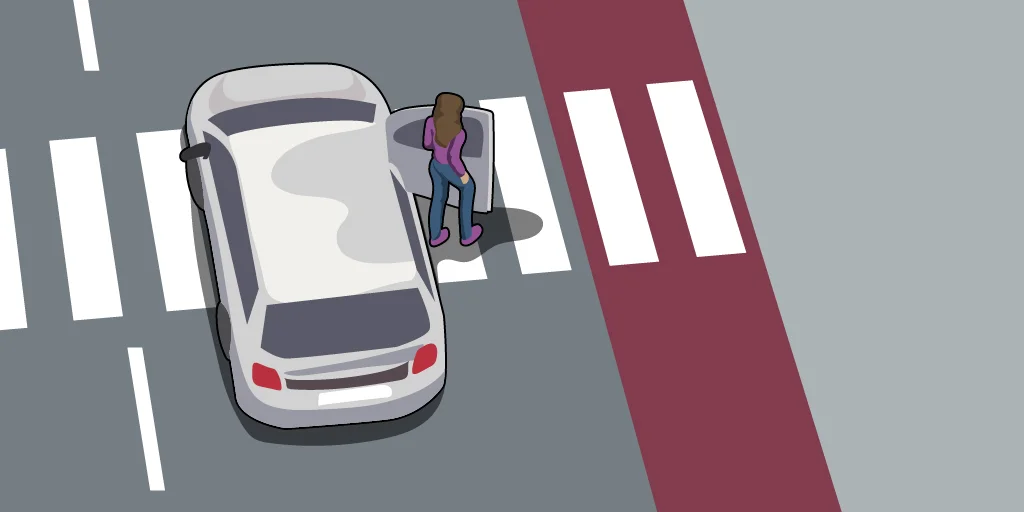
Pedestrian Crossings
You may not stop on a pedestrian crossing or within 5 metres of one. Pedestrians need clear visibility, and drivers approaching the crossing need to see them.
Bus Stops
If a bus stop has block markings on the road, you cannot stop within those markings. If there are no block markings, the rule is: stay at least 12 metres away from the bus stop sign.
There is one exception: you may briefly stop to pick up or drop off passengers, but only if you are not obstructing a bus.
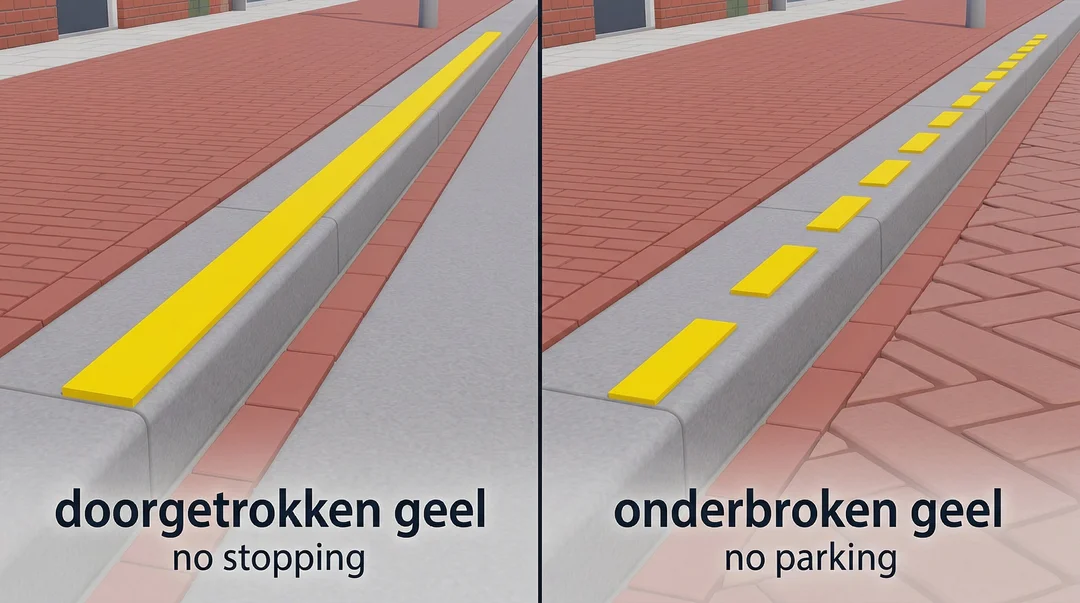
Yellow Continuous Line
A solid yellow line painted along the kerb means: no stopping on that side. Think of it as a painted version of the E2 sign.
Motorways and Expressways
On a motorway (autosnelweg) or expressway (autoweg), stopping is forbidden. These roads are designed for continuous, high-speed traffic. If you break down, move to the emergency lane and call for help — you're not "stopping" by choice in that case.
Where You Cannot Park
Everything listed above as a no-stopping zone is automatically a no-parking zone. But the parking prohibitions go further. Here are the additional places where parking is forbidden.
Sign E1 — No Parking
The round blue sign with a single red diagonal line is sign E1. It means: no parking on this side of the road. You can still briefly stop here (to drop off a passenger, for instance), but you cannot leave your vehicle or stay longer than necessary.
Like E2, this sign applies only to the side of the road where it's placed.
Yellow Dashed Line
A broken (dashed) yellow line along the kerb means no parking. Unlike the solid yellow line (which bans stopping entirely), the dashed line still allows brief stops.
Near Junctions
You may not park at a junction or within 5 metres of one. Parked vehicles near intersections block the view for drivers, cyclists, and pedestrians trying to cross or turn.
In Front of Entrances and Exits
Driveways (inrit/uitrit) must be kept clear. Never park in front of someone's entrance or exit — they need to get in and out.
Priority Roads Outside Built-Up Areas
Outside towns and cities, you may not park on the carriageway of a priority road. These roads carry fast-moving traffic, and a parked vehicle would be a serious hazard.
Spaces Reserved for Others
You cannot park in a spot that's designated for a different type of vehicle — for example, a disabled parking space if you don't have a permit, or a space marked for electric vehicle charging if you're not charging.
The same goes for:
- Loading and unloading zones — reserved for commercial vehicles actively loading
- Permit holder spaces — only for vehicles with the correct parking permit
- Spaces restricted to certain hours by a sub-sign
No Double Parking
Parking alongside another parked vehicle (double parking) is never allowed. It narrows the road dangerously and blocks the parked vehicle in.
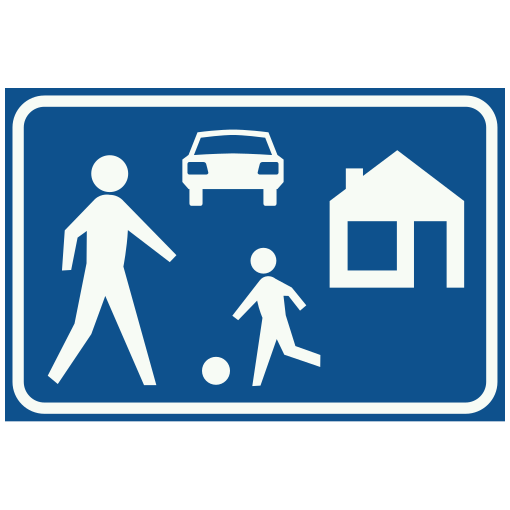
Home Zones (Erf)
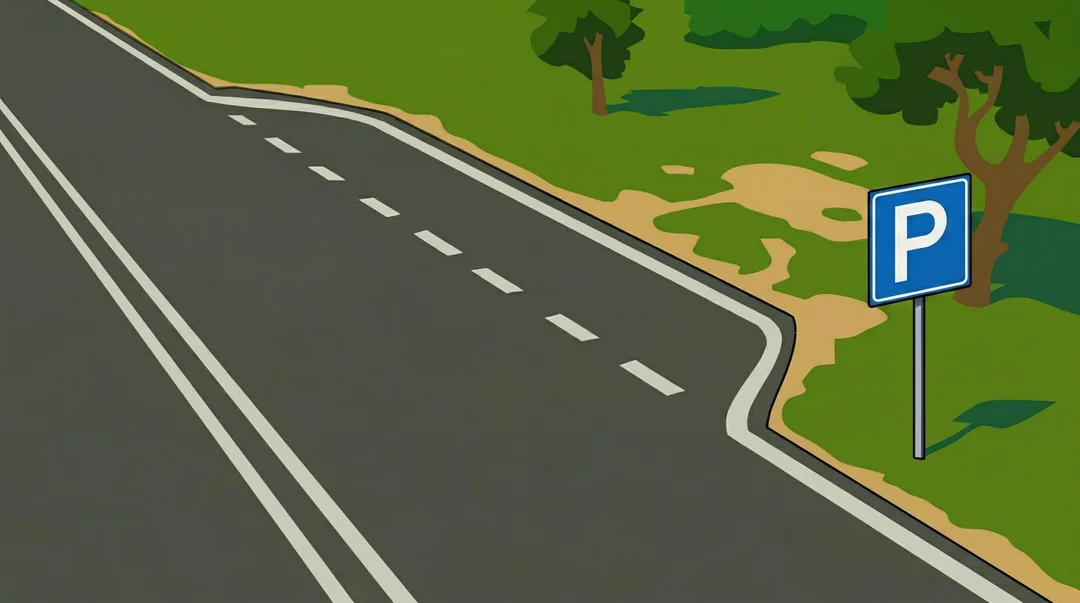
Inside an erf (home zone), you may only park in designated parking spaces — usually marked with a "P" sign or road markings. The rest of the space is shared by pedestrians, playing children, and vehicles, so random parking is not permitted.
Signs E1 and E2 — Zone Variants
Both the no-parking sign (E1) and the no-stopping sign (E2) have zone variants. When you see the word "zone" on the sign, the prohibition applies to:
- The entire area within the zone
- Both sides of every road in that zone
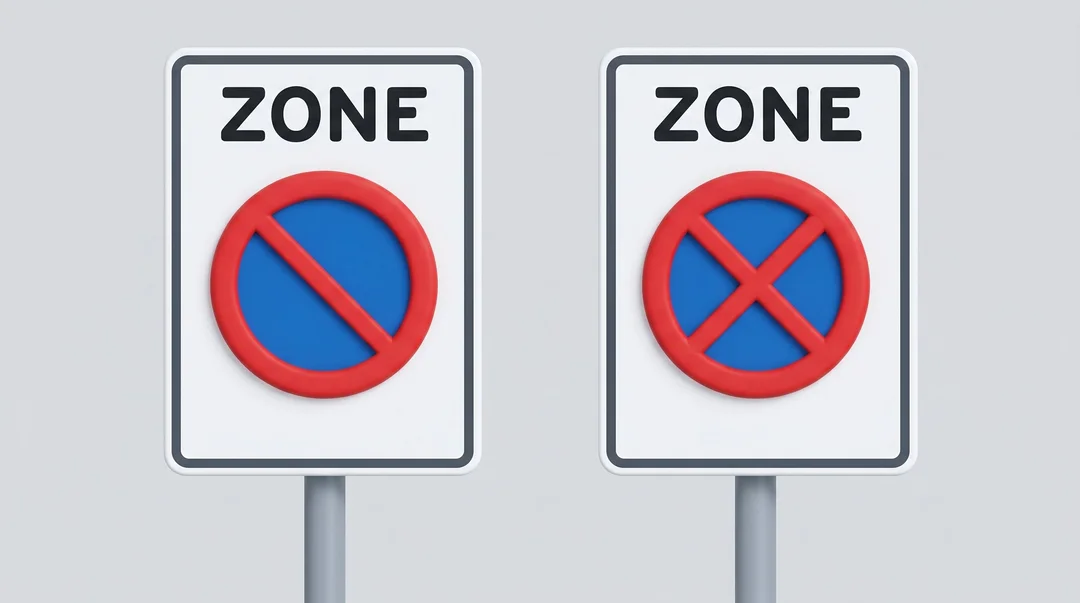
A regular E1 or E2 sign only covers the side of the road where it stands. A zone sign covers everything until you pass the matching "end of zone" sign.
Sub-Signs: Read the Small Print
Many parking and stopping signs have a smaller sign underneath — a sub-sign (onderbord). These modify the main sign and tell you exactly who or when the rule applies.
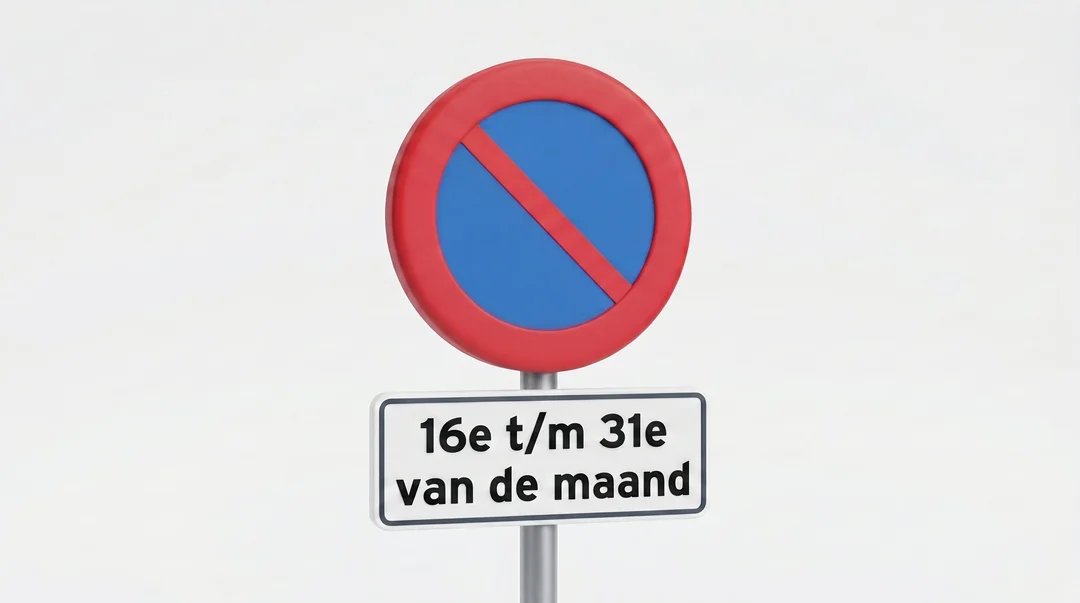
For example:
- "16–31" means the prohibition only applies during the second half of the month (days 16 through 31). On days 1–15, you can park there normally.
- A sub-sign might show a time window (e.g., "8:00–18:00"), meaning the ban only applies during those hours.
- Some sub-signs specify vehicle types or permit holders.
Always check for sub-signs — they can make the difference between a legal and an illegal stop.
The Parking Disc (Parkeerschijf)
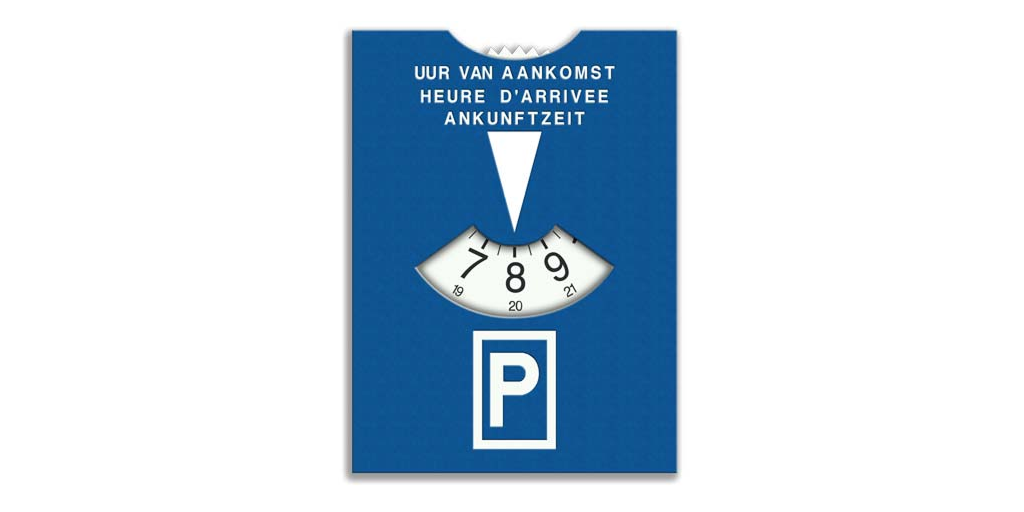
In certain areas, you'll need a parking disc — a flat blue card with a rotating arrow that shows your arrival time. Here's how to use it:
- Set the arrow to the next half hour after you arrive. For example, if you arrive at 12:15, set the disc to 12:30. Arrived at 9:45? Set it to 10:00.
- Place it behind your windscreen so it's clearly visible from outside.
- Do not change the time while your vehicle is parked. Adjusting it mid-stay is a violation.
The parking disc acts as proof of when you arrived, so enforcement officers can check whether you've exceeded the allowed time.
Important: A parking disc with a mechanism that automatically changes the arrival time during parking is forbidden. A compliant digital parking disc may be allowed, but it must keep showing the original arrival time.
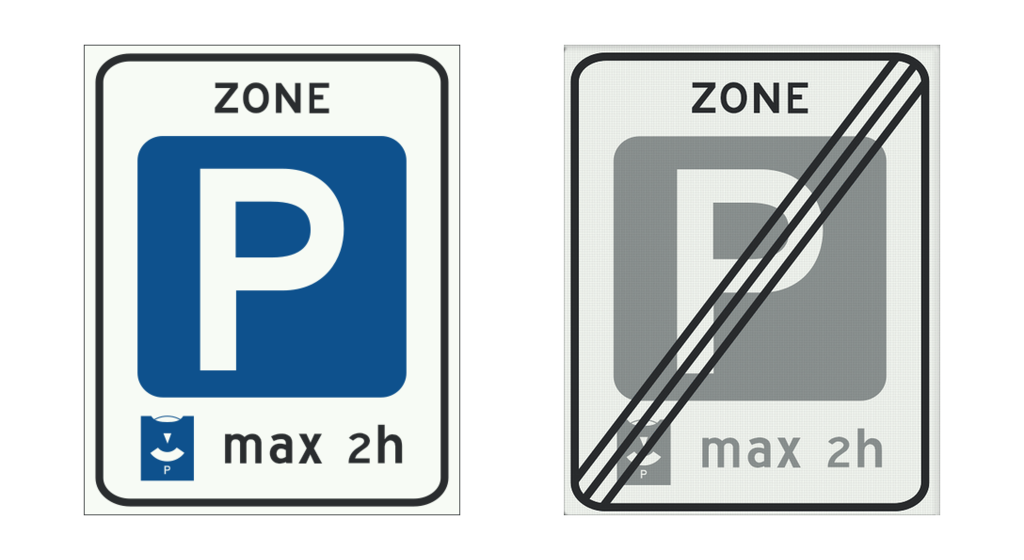
Parking Disc Zones (Blue Zones)
A parking disc zone (also called a blue zone) is indicated by sign E10. When you enter this zone:
- You may only park at spots marked with a P-sign, P-tile, or a blue line on the road
- The maximum parking duration is shown on the sign
- Motor vehicles with more than two wheels must display a parking disc (motorcycles and scooters are exempt)
- The zone may only apply on certain days or hours — check the sub-sign for details
When you see the "end of parking disc zone" sign, the blue zone rules no longer apply. Beyond this point, normal parking rules take over again.
Quick Reference: Stopping vs. Parking Rules
| Stopping forbidden? | Parking forbidden? | |
|---|---|---|
| Sign E2 (that side) | Yes | Yes |
| Sign E1 (that side) | No | Yes |
| Solid yellow line (kerb) | Yes | Yes |
| Dashed yellow line (kerb) | No | Yes |
| On/within 5m of pedestrian crossing | Yes | Yes |
| In/at a junction (the intersection itself) | Yes | Yes |
| Within 5m of a junction (the approach) | No | Yes |
| Bus stop markings (or 12m from sign) | Yes* | Yes |
| Bend, tunnel, hill, level crossing | Yes | Yes |
| Cycle path, footpath | Yes | Yes |
| Next to cycle/bus lane | Yes | Yes |
| Motorway / expressway | Yes | Yes |
| In front of entrance/exit | — | Yes |
| Priority road outside built-up area | — | Yes |
| Home zone (erf) — outside marked bays | — | Yes |
| Double parking | — | Yes |
* Exception: immediate passenger pickup/dropoff is allowed at bus stops if you don't obstruct the bus.
Exam Tips
- If stopping is banned, parking is always banned too. But not the other way around — where only parking is prohibited, a quick stop may still be fine.
- E2 is stricter than E1. The X means nothing — not even a brief stop. The diagonal line (E1) still allows stopping.
- Signs apply to one side only (unless it's a zone sign).
- Yellow solid line = no stopping. Yellow dashed line = no parking. Solid is stricter.
- 5 metres is the magic number — from pedestrian crossings and from junctions.
- 12 metres from a bus stop sign when there are no block markings.
- In the exam, if a scenario involves any kind of danger or obstruction, the answer is almost always: you may not stop or park there, regardless of signs.
Master these rules and you'll handle the stopping and parking questions on your CBR exam with confidence.